The discussion around MSF UK's controversial video sparked quite a lot of comments around the topic 'How do you portray aid and poverty' or 'How do you make people think about these subjects'.
So I thought it is a good idea to show another way. A way that touched me. Meet Emily Troutman. Emily Troutman is a writer and photographer living in Washington. She just came back after a month travelling around Kivu, in the East of the Democratic Republic of Congo (DRC). She made a video collage of her pictures, mounted it with some gripping music and appropriate text. Its simplicity took me in, and contrasted sharply with the MSF video we talked about a few days ago. Have a look for yourself:
I contacted Emily, and we had an interesting exchange:
Why did you make this video?
Emily: It was a rare opportunity to give voice to an issue that at this moment only exists at the fringes of the mainstream media.
Was this your first trip to rural Africa?
Emily: I also traveled with UNOCHA in the Gulu area of Uganda in 2006. I took some wisdom and knowledge from that trip into Congo. For example, I already knew what real poverty and starvation looked like, so I was able to pay attention to what could maybe be called higher-level needs, but are still urgent: space, pots to cook in, blankets. Of course in Congo, the biggest issue is safety.
What was different in the experience between the two trips, Congo and Uganda?
Emily: In Congo, I generally saw less hungry people, but still some malnutrition, and a whole new complexity of issues facing internally displaced people (IDPs). In Congo, IDPs are still running in a way that they were not in Uganda in 2006. I was also profoundly impacted by the enormity of the jungle in Congo. My four day trip to Pinga, through an area where civilians and aid workers have been shot, really brought home the sense of danger that the Congolese face in simple day-to-day tasks like gathering wood, or walking to market.
These are areas where the authorities or even the people, are not always happy to see a photographer
Emily: The DRC was a very frustrating place to take photos because the work I was doing was technically illegal.
It is exceptionally difficult to get permission to take photos there, so most of the time when I shot, it was in IDP camps or traveling with UN MONUC escorts. I have a profound respect for those photographers who risk their lives to take photos of the military or shine light on issues like child soldiers.
But DRC.. So many have published stuff about the DRC?
Emily: I recognized that Congo, like so many intractable problems, has a way of receding into the noise of daily life. Even for me, it became one of these world crises that are too far away and too foreign to matter on a daily basis. It becomes hard to summon the energy to pay attention. Like, why even look at the issue if I can’t do anything to help?
And did you? Did you help?
Emily: I wanted to go, just so I could see. And ultimately, to decide if that experience of seeing and sharing what I saw could transform how all of us think about Congo, and more generally, the problems of “other people.” Although I have written and photographed similar issues in the past, Congo seemed uniquely overlooked, especially in light of the scale of its tragedy.
People talk a lot about “awareness” and “action” and “making a difference.” But honestly, this was not an aspiration of mine. I only wanted to be open to the moment and encourage those I photograph to also be open to me. The next part is like a witnessing, seeing what happens when two people enter a silent pact to tell the truth. I wanted to make the video because it is an easy way to draw people in; a photo doesn't ask anything of us except our attention.
You can find the stories behind the pictures, on Emily's blog. More of her work, you can find on on her website.
Friday, September 04, 2009
Advocacy, the other way: "Why Congo Matters"


Big oil strike fuels Congo conflict

Published: Sept. 3, 2009 at 6:36 PM
The oil was found in July 2007 by Tullow Oil of Ireland and Heritage Oil of Canada in Lake Albert, which lies on the border with Uganda and is part of the system of the Upper Nile.
The field is now estimated to hold several billion barrels of oil. If that proves to be accurate it will be the largest onshore field found in sub-Saharan Africa in two decades.
Initially, Heritage estimated the field contained 600 million barrels, but later pegged the deposits on the Ugandan side at 2.4 billion barrels worth an estimated $7 billion.
Tullow estimates that the Congo deposits included a vast reservoir of natural gas that could produce 14 million cubic feet per day.
However, development of the field will require a 750-mile pipeline to the Atlantic coast to the west -- and an oil price of $80 per barrel to make it commercially viable.
The increased activity in the oil sector has attracted several international security companies that will be needed to protect the oil facilities, fueling the tension in the war-torn region where many of Congo's neighbors either have military forces in action or support paramilitary proxies.
Uganda, Rwanda, Angola, Namibia and Zimbabwe among others have been caught up in the conflict at various times in which some 5 million people have perished, mainly from disease and starvation.
The DRC, a country of 63 million in the heart of Africa that is a big as Western Europe, has been ravaged by war for 15 years.
The civil war that erupted in 1998, a spillover of the genocidal war in Rwanda, supposedly came to an end in 2003 when a peace settlement was reached by the main protagonists and a transitional government established in the Congo.
But fighting has continued in the lawless eastern part of the country where rebel holdouts still plunder, rape and murder.
The Congo is immensely rich in resources, such as gold, copper, diamonds, uranium and tantalum, known as coltan, which is used in electronic devices such as cell phones and computers.
But it is also rich in water power. The flow of the mighty Congo River could one day light up the entire continent.
And this could also become a cause of conflict in a region where war and slaughter are endemic.
Plans to link Europe to the world's biggest hydroelectric dam project are causing growing controversy, amid claims that diverting electrical power to Europe would rob needy Africans of their birthright.
Supporters of the project say that the 40,000 megawatts of power the $80 billion Grand Inga Dam on the Congo River could generate would double the amount of electricity available in all of Africa.
Right now, only 30 percent of Africans have access to electricity, but that drops to less than 10 percent in some countries.
Even so, the Grand Inga electrical output is twice as much as the world's current largest dam, the Three Gorges project in China, and it could accelerate industrialization across Africa in the span of a few years.
The World Bank supports the scheme. It concedes there is concern that a project that could provide electricity for 500 million homes in Africa, from Cairo to Cape Town, might also have some of its power diverted to Europe and even Israel.
But they stress that the success of the ambitious project could hinge on exporting energy to wealthy countries to ensure the scheme gets financing from international banks and other investors.
"We need creditworthy anchor customers to subscribe so investment can go ahead," explained Vijay Iyer of the Africa Energy Group at the World Bank.
© 2009 United Press International, Inc
Advocates for Congo rape victims brutalized

FOREIGN AFFAIRS REPORTER
Congolese women's rights defender Justine Masika Bihamba was in her car one day last October when her sons, aged 7 and 13, were dragged out by uniformed men and beaten in the street.
It wasn't the first time her family was threatened. A year earlier, six men, reportedly uniformed soldiers, broke into her home in Goma in the lawless eastern Democratic Republic of Congo (DRC), and tied up Bihamba's six children, before sexually assaulting a daughter.
It was a brutal warning that not only victims of sexual violence, but those who try to support them, are targets in a territory that is the heart of darkness for Africa's women. The level of sexual violence is so extreme the United Nations has called it unprecedented.
Yesterday Bihamba, who co-ordinates the Synergie des Femmes Contre les Violences Sexuelles, took her protest against Congo's war on women to Ottawa.
With Alex Neve, who heads Amnesty International Canada, she handed a petition of 20,000 Canadian signatures to the DRC embassy, urging that the government protect her and the many women who are raped and sexually mutilated in the eastern part of the country.
"My children are badly traumatized," Bihamba said in a phone interview. "But I can't leave DRC. I have to do my work."
There is an ever-increasing amount of work to do, as women are attacked by all sides in a bloody free-for-all in which government troops battle Rwandan militias who have fled across the border to evade justice for the 1994 genocide, ethnic militias clash, and criminal gangs fight each other for the region's mineral wealth.
When U.S. Secretary of State Hillary Clinton visited female victims in the DRC last month, she said she had come face to face with "evil in its basest form."
She pledged $17 million (U.S.) to document sexual violence and train doctors and police – including female officers – to combat the epidemic of rape that often includes sexual torture. By attacking women, the rapists aim to humiliate and break the spirit of their opponents.
But easing the plight of women in the eastern Congo is a task that requires more than a single country's efforts.
Meanwhile, Bihamba's overstretched network of volunteers helps victims get medical help, counselling, legal aid and rehabilitation in communities that may reject them. The group sets up small economic projects, like farming, to give the often-destitute victims an income to survive.
But Bihamba herself has not been able to find justice for the attacks on her family – an example of the impunity that reigns in the eastern Congo, in spite of the government's official opposition to violence against women.
"I've met with people representing military justice," she said. "I was told that the men who did these things are well protected."
Congo expose: Rape used as tool of war

THE WASHINGTON TIMES
The Washington Times is running a weeklong expose beginning next Tuesday titled "The Lost Story of the Lost Continent: How Rape Is Used as a Tool of War in Congo." The 27-year-old newspaper in the nation's capital dispatched its U.N. correspondent Betsy Pisik and award-winning photojournalist Mary Calvert for six weeks to the war-torn Democratic Republic of Congo to investigate the causes and consequences of a rape epidemic that is destroying the social fabric of communities and undermining hopes that Congo can overcome its history as a failed state.
Together, they went beyond statistics to explain why the epidemic persists despite the efforts of the United Nations, the United States and myriad nongovernmental organizations. In words and photos, they also documented the victims -- from small children to elderly women -- the perpetrators and those who seek to heal the terrible wounds and to end the cycle of violence and impunity. Their work was funded in part by a grant Ms. Calvert obtained from the White House News Photographers Association.
"I kept reading little snippets about the Congo and all the women being gang-raped," says Ms. Calvert, a Pulitzer finalist and winner of the 2008 Robert F. Kennedy International Journalism Award. "In the mass thicket of news, they were like someone screaming from the bottom of a well. I knew this was a story that had to be told."
"No one knows how many Congolese women have endured sexual torture over the last decade, nor how many survived the experience," Ms. Pisik says. "We talked to government officials, ravaged victims, their predators, and good Samaritans who try to offer material, medical, spiritual and emotional support to try to find out how a humanitarian crisis like this could spiral so far out of control."
The Times is committing nearly two dozen pages of its newspaper over three days to its coverage of the crisis, including an eight-page special section Tuesday tied to the first day's front-page story. The special section is designed to introduce unfamiliar Americans to Congo, its history, its conflict, its shame and its potential for growth if it can emerge from chaos and lawlessness. The Times has created a special Web landing page to capture all of its multimedia work, including photos, video, audio and graphics and will create companion pieces on its radio and TV services.
"So much of the world has focused on the crisis in Darfur, and rightfully so. But the swath of personal destruction in Congo is exponentially bigger and its victims get disproportionately less attention," Executive Editor John Solomon said. "We wanted to the use the power of visual storytelling to report this story in four dimensions and to give voices and names and faces to the pained victims that so few in America know about."
The Congo series follows a similar project by the Washington-based newspaper in August that documented the rapid rise of mental illness among Katrina's victims in New Orleans. The project was cited worldwide from the halls of Congress to the alleys of Bourbon Street and showcased the newspaper's growing multimedia platforms on radio, television and the Web.
New court hitch for Congo war crimes suspect

(AFP)
THE HAGUE — The International Criminal Court said on Friday it had postponed hearings planned for next week to examine six states' willingness to host a Congolese war crimes suspect ahead of his trial.
A pre-trial judge said it was not "feasible, at this stage, to proceed with convening the public hearings as initially scheduled" in the case against former Democratic Republic of Congo vice president Jean-Pierre Bemba.
The court's latest ruling follows the filing of an appeal by prosecutors against a decision last month to grant Bemba a conditional release ahead of his trial, for which no date has been set.
It said at the time that Bemba would have to stay in detention until a country is found that is willing to host him, and invited Belgium, Portugal, France, Germany, Italy and South Africa to make "observations" at hearings scheduled for September 7 to 14.
These were countries to which Bemba had asked to be released. Most of them have raised objections.
The five European countries had asked for the hearings to be postponed, while Bemba's lawyers had sought the DR Congo to be added to the list.
On Thursday, the ICC said Bemba would have to remain behind bars pending the outcome of the prosecution's appeal against his ordered release, even if a host country is found in the meantime.
Given the possibility that an appeals chamber may overturn the decision to free Bemba, the court therefore postponed the country hearings until after the appeal is decided.
Bemba, 46, stands accused of three charges of war crimes and two of crimes against humanity allegedly committed in the Central African Republic (CAR) from October 2002 to March 2003.
He will stand trial for acts of murder, rape and pillaging allegedly committed by members of his Congolese Liberation Movement (MLC) while helping troops of then CAR president Ange-Felix Patasse fight off a coup bid.
Copyright © 2009 AFP
The Rape of the Congo
--Zach Schubert
The UN calls the Democratic Republic of the Congo the new rape capital of the world. By their estimate, 35,000 women have been raped there since January. As ethnic militias continue to fight a decade long civil war, the use of sexual violence as a weapon of terror has risen to an almost unprecedented level.
In the late 19th century, the Congo Free State was founded as a colony of Belgium. Since it abruptly gained independence in 1960 it was immediately bogged by corruption. When Mobutu Sese Seko seized power in 1965, briefly renaming the country Zaire, he presided over a notoriously corrupt and inhumane government. He was overthrown during the Rwandan civil war, after the Rwandan government supported a Zairian rebel group in the hopes of clearing Tutsi camps that had crossed the border. When the newly installed president, Laurent D. Kabila, again split with his Rwandan supporters a year later, a second civil war sparked what would become "Africa's first world war." A decade later, Congolese troops continue to clash with Interahamwe, the Rwandan rebels who first started the genocide.
Although ethnic violence is pervasive, it also masks a deeper struggle over the Congo's uniquely valuable resources. The Congo, as large as Western Europe, contains 80 percent of the world's coltan. Coltan, a metal that conducts heat exceptionally brilliantly, is an essential component in cell phones and laptops. It can be mined by anyone will a shovel, leading to shallow pockmarks all across the country. It is largely for this reason, under the pretense of hunting Tutsi fighters, that the Interahamwe persist.
The practice of rape as a weapon of war spread to the Congo through the Interahamwe, though now soldiers on both sides use it. The weapon's power is its ability to demoralize an enemy. Says Zainab Salbi of Women for Women International, "When a husband is forced to see the rape of his wife or his daughter in front of him, this is a complete emasculation of the husband, and telling the whole society that we are destroying the most respected members of your society."
In recent months, this tactic of humiliation has found a new outlet: men raping other men. Homosexuality is taboo in Congolese culture, and the trauma victims suffer can be crippling. Many seek help only if their health is threatened. Others, unwilling to suffer the shame, die untreated.
Adding to the danger is the increasing spread of sexually transmitted disease and HIV. In a country where HIV is already rampant and medical resources are scarce, rape wards have shown a surge of HIV positive patients.
Joining us via Skype this week is Keith Harmon Snow, an independent journalist, war correspondent and photographer. Keith has worked as a genocide investigator and serves on the advisory board of the Friends of the Congo. He will further discuss the history of the conflict, as well as the role of the Congolese and Rwandan governments.
Also Skyping in will be RUTV political analyst Omoyele Sowore. He will deliver his own analysis on the culture of rape based on his experiences as a journalist in Africa.
We're live at 6pm (EDT) Wednesday and on demand at www.livestream.com/reportersuncensored.
Follow Reporters Uncensored on Twitter: www.twitter.com/reportersuncens
voices from the war in eastern congo
This short documentary gives a voice and a face to people living in areas of eastern Democratic Republic of Congo (DRC) who are largely neglected by the international community. The film is a result of the close collaboration between Medecins Sans Frontieres (MSF), World Press Photo laureate Cédric Gerbehaye and Mediastorm. To watch the full-length feature visit Condition Critical.
Insecticide-treated bed nets reduce infant deaths in Democratic Republic of Congo

DRC Rebel Group Faults Government over Agreement
02 September 2009
In the Democratic Republic of Congo, a rebel group is scheduled to hold a news conference Wednesday to demand the full implementation of a recently signed agreement.
 |
| Secretary of State Clinton (left) and Congo President Joseph Kabila, 12 Aug 2009 |
But President Joseph Kabila's government says the accusations are without merit. Spokesman Lambert Mende has described the rebel group as bandits who would be decisively dealt with.
Under the Goma agreement, the government was to release all jailed rebels as well as incorporate them into the national army.
Didier Bitaki, a leading member of the rebel Mai Mai group said that his group is disappointed in the government's stance.
"Today Wednesday, we have a press conference to explain to people the peace process that started in Goma in March 23,because already we are anxious… since four months after the peace process was started, there is nothing that has been done (correctly) from what we agreed with the government," Bitaki said.
He said the government has failed to live up to its responsibility under the agreement.
"We have to express our disappointment regarding (the agreement) and that is the reason why we need the press conference to explain and let people know how things are going," he said.
Bitaki accused the government of failing to consult with rebel negotiators.
 |
| Congolese soldiers march from Kibati, north of the provincial capital of Goma, as civilians flee the area, 7 Nov. 2008 |
"If they were preparing something from the former armed groups they could be consulting them… I'm one of the representatives of the armed group in the National Commission of the Fellowship of the Accord, but I don't have any information, Bitaki said.
Kinshasa has, however said the implementation of the Goma agreement is on course.
"I'm sure that this group that is saying so is not a representative of the majority of the Mai Mai. I know that something like 80 percent of the Mai Mai has already joined the re-integration process," said government spokesman Lambert Mende.
He said there are other insurgent groups who have been undermining the agreement.
|
|
|
|
"I know that a small minority group I think called Pareko and another group Yakutumba out of tens of tens of groups have shown some reluctance to join this disarmament exercise," he said.
Mende said the rebels have failed to abide by the peace agreement.
"They are trying to extend the period where they can continue looting and misbehaving, raping and we totally oppose this way of doing thing," Mende said.
He said the government is determined to end the insurgency.
"We have started to crash them. We cannot be under the pressure of a minority," he said.
 |
| Map of Democratic Republic of the Congo |
"It is a lie. There is no other specification in the agreement only that they (rebels) have to join the army. And when you join a governmental army, you just abide by the law by the rules of the army. You can't come with your own rules as if you are building a new army," Mende said.
Earlier this year, the Mai Mai rebel group expressed frustration with the government and threatened to take up arms, a move experts believed would undermine the peace process.
Meanwhile relative peace has reportedly returned to the restive North Kivu province since the signing of the agreement between Kinshasa and armed groups.
MONUC Chief and basketball star Dikembe Mutombo meet, discuss DRC health care

Kinshasa, 2 September 2009 – Congolese-born basketball star Dikembe Mutombo paid a courtesy call to MONUC head Alan Doss at headquarters in Kinshasa last Friday. The two had an informal discussion of the challenges in providing medical care to impoverished and under-served populations in post-conflict societies, and Mr. Mutombo’s efforts in this direction through the Biamba Marie Mutombo hospital in Kinshasa, supported by his foundation.
During their discussion the Special Representative the Secretary General and the Unicef Goodwill Ambassador discussed the need for innovative arrangements for guaranteeing high quality and sustainable healthcare. A central question was how to help cover the costs of healthcare, particularly for poorer people.
Among the possible avenues to be explored was the possibility of creating frameworks to help people finance medical care. Mr. Mutombo has been discussing with the international financial organizations the possibility of creating a micro credit system to finance medical insurance.
Mr. Mutombo indicated that a meeting is planned in Chicago next October to kickstart this project, which is very close to his heart.
“In post conflict societies like the DRC, the many demands on the States resources make it impossible to meet all needs. Public-private partnerships offer a possible means for making available resources for essential services like medical care,” underlined Mr. Doss.
Mr. Mutombo, who is also a UNICEF Goodwill Ambassador, has had a distinguished career in NBA basketball. In 2007, his foundation opened a modern hospital named in honour of his mother, Biamba Marie Mutombo, in the Kinshasa suburb of Masina. “I wanted to aid the poorest people in this part of Kinshasa, which is also one of the most populous,” he said.
The 300-bed hospital has three operating rooms, an outpatient clinic, an emergency room and a pharmacy. It is equipped with high technology equipment that allows the hospital to carry out state of the art operations and surgeries, in specialized fields such cardiology, neurology and orthopedics, and pediatric services, among others.
Mr. Mutombo retired from professional basketball in April 2009 after 18 seasons at the highest levels of the NBA. He now hopes to concentrate his energy on his foundation and his family because “my life doesn’t stop, I will continue with my activities and I hope to help my compatriots who have suffered a lot,” he said.
European ‘mercenaries’ face death penalty in Congo
Two alleged mercenaries from Europe are facing the death penalty in the Democratic Republic of Congo after being accused of murder and spying.
Looking pale behind unkempt beards, Joshua French, 27, and Tjostolv Moland, 28, both from Norway, were charged with murder, attempted murder, espionage, conspiracy and armed robbery after their driver was found dead with a gunshot wound to his head in May this year.
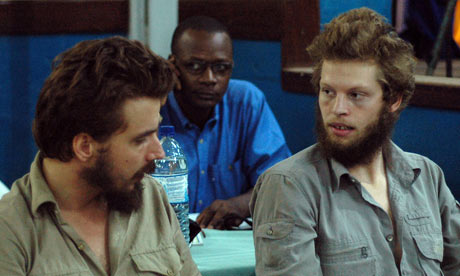
Norwegians Tjostolv Moland (l) and Joshua French (r) attend a military tribunal in Kisangani, Democratic Republic of Congo. Photograph: Thomas Hubert/Reuters
“May it please the garrison military court to say that the accusations against Tjostolv Moland and Joshua [French] are established and to sentence them … to the death penalty,” the prosecutor, Major Jean Blaise Bwa Mulundu, told the court last week, according to Reuters.
Norway has strongly expressed concerns that the men are not receiving a fair trial. French himself said: “I don’t think any recognised nation would accept this trial in any way or accept any of the evidence.”
A murky chain of events led the two men to the grim military courtoom of Kisangani in the lawless east of Congo.
French and Moland were reportedly in the country to set up their own security company. The website Private Military Herald, which monitors the private security industry, claimed that Norwegian military ID cards, counterfeit UN hats and employee ID badges with both correct and false names were found by police at an apartment shared by the two men in Uganda.
The employee badges were believed to use the logo of a Norwegian security company, Special Interventions Group (SIG), on false pretences. A source at SIG said: “We were supposed to have a partnership with these guys a year ago but it didn’t happen. They decided to try it for themselves and start their own company. Unfortunately they chose our name and used our ID cards.”
The source added: “We don’t believe for a second these guys killed anyone. They’re just kids who went abroad, tried to think big and set up a company. I don’t have a bad word to say about them. They loved Africa and they did not want to be mercenaries.”
French and Moland had previously served in Norway’s armed forces. Norwegian diplomats say there has been no contact between the accused and their country’s military or any other official organisation since 2007.
It is not clear what the two accused were doing in the area. Former soldiers are frequently taken on by private security companies who have stepped up interest in the region due to oil discoveries under Lake Albert, which lies on the border between Congo and Uganda.
French and Moland have said that 47-year-old driver Abedi Kasongo was shot and killed when their car was attacked by gunmen on the road, 60 miles east of the town of Kisangani.
The men were travelling in Congo’s north-eastern Orientale province, which is still unstable and plagued by armed groups six years after the country’s war officially ended. But the region is starting to attract investors after the discovery of billions of barrels of oil on the Ugandan side of the border by London-listed Tullow Oil and Heritage Oil.
The prosecution demanded last week that Norway pay Congo $500bn in damages over the incident.
Mulundu requested the death penalty for each of the five charges against the two defendants. The verdict is expected to be handed down by the military court this week.
Dikembe Mutombo Launches Training Centers in His Congo Hospital

Posted by Quibian Salazar-Moreno on Sep 1st 2009
Our friends at Athlebrities.com hipped us to retired basketball great Dikembe Mutombo's decision to add two centers to his recently opened Biamba Marie Mutombo Hospital and Research Center in the Democratic Republic of the Congo.
According to Athlebrities.com, the two centers, an Immune System Monitoring Laboratory and an Occupational Safety Center for Health Workers, will train more than 300 clinicians and improve monitoring and treatment of patients living with HIV/AIDS.
"The doctors and nurses at the Biamba Marie Mutombo Hospital are saving lives every day and helping improve health care in the DRC, which has been ravaged by more than a decade of war and disease," Mutombo said at the opening ceremony. "These centers of excellence are an important milestone in improving the quality of life for those who live with HIV/AIDS and in training new health care workers to help prevent the spread of disease."
The $29-million facility opened in 2007 and sits on 12 acres of land with 300 patient beds. Check out Mutombo talk about the hospital in the following video:
Congo: Midwives Transform Trash Into Hope

Since Secretary of State Hillary Clinton ended her African trip, the news cycle has seemingly abandoned the women of Congo--women who soldier on despite overwhelming odds that make staying alive a gauntlet rife with terrible odds. But lives continue to unfold, babies are born, mammas die, and hope burns with a fire that even the rainstorms which pummel the plastic dwellings at the Mugunga I displacement camp cannot extinguish. Secretary Clinton spoke eloquently about her experiences at Mugunga I and she is a powerful witness to the societal breakdown in eastern Congo.
The Mugunga Internally Displaced Persons Camp sits in a land of volcanoes and great lakes on the edge of Goma, a provincial capital in the eastern Congo. The camp is now home to 18,000 people seeking refuge from a cycle of violent conflict that has left 5.4 million dead since 1998. Chased from their homes and villages by armed rebels and informal militias, these men, women and children walked for miles with little food or water until they reached this relatively safe haven.
Now they live in tents, one next to the other, row after row, some clinging to life, others hanging on to whatever glimmer of hope remains in a region plagued by years of brutality. Many of these people have been robbed of their homes, possessions, families and, worst of all, their dignity.Women and girls in particular have been victimized on an unimaginable scale, as sexual and gender-based violence has become a tactic of war and has reached epidemic proportions. Some 1,100 rapes are reported each month, with an average of 36 women and girls raped every day.
(I) met a woman who told me that she was eight months' pregnant when she was attacked. She was at home when a group of men broke in. They took her husband and two of their children and shot them in the front yard, before returning into the house to shoot her other two children. Then they beat and gang-raped her and left her for dead. But she wasn't dead. She fought for life and her neighbors managed to get her to the hospital - 85 kilometers away.
I came to Goma to send a clear message: The United States condemns these attacks and all those who commit them and abet them. They are crimes against humanity.
These acts don't just harm a single individual, or a single family, or village, or group. They shred the fabric that weaves us together as human beings. Such atrocities have no place in any society. This truly is humanity at its worst.
But there is reason to hope. We have seen survivors summon the courage to rebuild their lives and their communities. We have seen civic leaders and organizations come together to combat this appalling scourge. And we have seen health care workers sacrifice comfortable careers so they can treat the wounded.
The midwives who fight to preserve new life as babies struggle to enter the world in the Mugunga camps and in the villages are tired, but their courage overcomes discouragement. When we visited with them in January of this year, their requests were simple. "Do not forget us." "We have no means to feed our own families." "Some cloth for the babies would be nice."
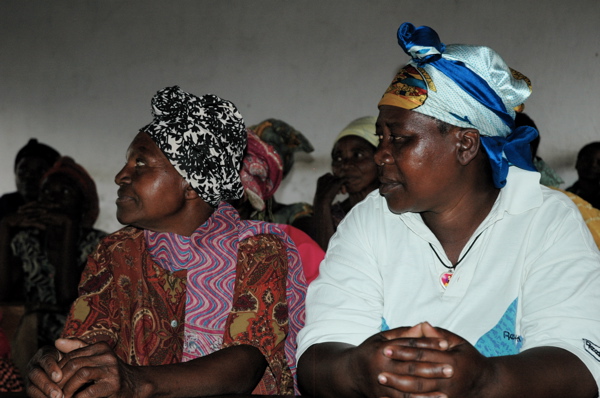
Thanks to the efforts of Emmanuel De Merode, director of Virunga National Park, there is now hope and opportunity for the Association pour la Promotion de la Sage Femme (APROSAF) midwives. 118 wise women ("sage femme" means " wise woman") form the backbone of APROSAF, which was created in the wake of the 2002 Nyiragongo eruption order to help families made homeless by the devastating lava flow that buried Goma. These traditional midwives of APROSAF are considered community leaders. The respect they garner results from selfless dedication as they transport pregnant women and rape victims, sometimes by carrying them on their backs, to get help. They do this without pay and subject themselves to rape and shootings along the way.
These courageous women, who now fight overwhelming odds in the face of a total societal and moral breakdown, will receive a stipend of $20 US per month to establish a unique briquette business. The midwives will transform refuse into precious fuel, thereby saving not only the lives of women and children, but also protecting the severely endangered ecosystem of Virunga Park, home to the last remaining mountain gorillas. In addition, the women will receive $.50 for each bag of briquettes they sell.
The humanitarian crisis cannot be overstated. Since the start of new military operations against rebel armies in January 2009, more than 800,000 people have been forced to flee their homes in North and South Kivu, according to the United Nations. Another 250,000 have fled their homes in northern Congo. The UN estimates that the total number of internally displaced people throughout the DRC is over 2 million.
Due to the ongoing fighting in eastern DRC, massive relocation camps are now located on the perimeter of Virunga Park. Secretary Clinton visited one of these camps, Mugunga I. People need fuel to cook and to keep their children warm. Until De Merode's appointment after a series of environmental scandals, there had been an effort to keep the displaced from harvesting wood in Virunga. As a humanitarian gesture, and after being appointed as chief warden in August 2008, he removed the charcoal barrier at Kibati Camp. Prices in Goma dropped from 33 to 16 dollars a sack in the weeks that followed as a result of a massive increase in supply from the park, and considerable damage was inflicted on the ecosystem. If each midwife can sell 10 sacks of briquettes a month, it will replace more than 1000 sacks of charcoal that would have come from the trees of Virunga National Park.
The issue is access to energy for fuel and this represents a classic human/wildlife conflict. Energy infrastructure in eastern Congo is a non sequitur. There is no fuel supply in the displacement camps, and women are desperate for charcoal to provide the most rudimentary means of sterilization, cooking, and heat. The biggest threat to the mountain gorilla, beside war, is the rapid deforestation of their mountain habitat. When the old-growth forest goes, so follows the fate of the mountain giants.
In an interview in January De Merode said that he still believed "wildlife should not take priority over peoples' needs."
Sometimes it is a strong belief that leads to solutions, causing faith to transform into hope for the beleaguered and abandoned. DeMerode understands this conflict. 1.2 million humans are in as much danger as the gorillas. If one adds up the column inches both online and in print over the past three years, it is obvious that Western news reports have focused on the gorillas above all human concerns. We presented this conundrum to De Merode in January.
You are right in claiming that, by focusing on charcoal, we are neglecting some of the more pressing humanitarian needs. But we have to look ahead. Virunga's forests cannot last more than 5 years with the amount of charcoal that is coming out of the park. When the forests are gone, Goma will suffer a massive energy crisis, and that will quickly become a humanitarian catastrophe: domestic energy is key to people's survival. They need domestic energy for food and for their health.
Charcoal is incredibly destructive and inefficient. When people cut the tree they only use the branches because they don't have the tools to cut the trunk and it is a huge amount of waste. We have to find an alternative. It's a human priority as much as it is a priority for the wildlife.
No problem, no fight for the right path is without a moral compass, and righteous direction can lead to solutions to challenges that once seemed impossible to conquer. The US-based Legacy Foundation developed a process by which fuel is created from grass, sawdust and debris--thereby transforming waste and garbage into energy. 5000 presses will replace the charcoal demand of Goma, and create 30,000 sustainable jobs.
Besides the need for an income so that the APROSAF midwives can continue their courageous work of walking through the conflict areas to carry rape victims and dying pregnant women on their backs to get medical aid, the dream of the APROSAF midwives is to see the completion of a clinic building which will serve as a way station. Estimates are that they could save up to seven lives per day. The relatively paltry sum of $100,000 will accomplish this, but so far there have been no American foundations or individuals willing to entertain this life-saving project.
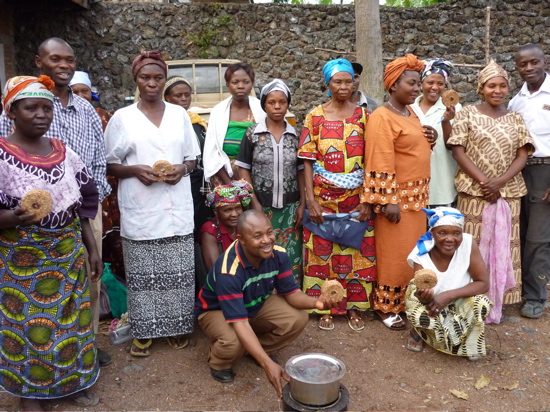
IMAGE courtesy of APROSAF midwives
Despite having little money to work with in his own programs, DeMerode has indicated that he will be donating some additional funds to aid this project. Not nearly enough to fund the clinic program, but something that will generate even more hope for the brave midwives.
Secretary Clinton in indicated that she is willing to infuse up to $17 million into eastern DRC. One would hope that there is a spare $100,000 available. The APROSAF midwives have some hope now, due to the generosity of the officials of Virunga Park. But lives cannot be saved nor the future ensured through hope alone.
Clinton spoke to a group of Congolese at a roundtable discussion while in Goma. Clinton's words held concrete pledges of support.
On each and every one of the points that you made, we will try to help. But I want to emphasize something I said yesterday, when I spoke with the young people. Just as President Obama said in his historic speech in Ghana, the future of Africa is up to the Africans. The future, ultimately, of the Congolese people is up to the Congolese people. There have to be changes, politically. There have to be changes in the impunity. There have to be changes that only the people of this country can demand, and can help bring about.
We will try to provide the help that we're both asked for and that we think could be useful. But, ultimately, that help has to be received, changes have to be implemented, people have to be committed. And I hope that we're beginning to see that, here and in the region and internationally.So, there is much to be done. I do not want to over promise. I am not just here to leave a business card, but I don't have a magic wand, either. But what I do pledge to you is that we will work. We will work hard. We will work with your government, we will work with groups like many of you represent. We will work with individuals, the private sector, and civil society, to try to help resolve the conflict and provide a better future.
But it is ultimately up to the people here. And I have seen so many examples of courage. I know the Congolese people do not lack in courage. And I know they do not lack in hard work or perseverance or survivorship.
Secretary Clinton did not have opportunity to meet with grassroots organizations such as the APROSAF midwives. Here is hoping that her staff will meet with them and others as they scope out opportunities for women of courage in Congo. APROSAF is community organizing in the best sense of the word. The midwives deserve attention and a drumbeat of support from the United States. How rewarding it would be to see immediate results on the ground in the form of babies suckling from breasts rich with milk, their mothers safe from the rapist, and cradled gently in the strong arms of the wise women midwives.
The midwives need the means to accomplish their noble goal of saving women through direct intervention, HIV/AIDS counseling, and nutrition. This is truly a grass-roots effort with a humble beginning that literally transforms grass and roots into life-supporting energy.
For a summary of the conflict in DRC please see this report from Human Rights Watch.
Follow Georgianne Nienaber on Twitter: www.twitter.com/nienaber
Tintin to be sued for Congo book

According to the British online news service, Telegraph.co.uk, a Congolese accountant is set to bring a lawsuit in France against Tintin for racism.
The case was originally brought to Belgium courts two years ago but with little result. Now, with the suit in France, the plaintiff, a Mr. Bienvenu Mbutu Mondondo, is hoping for better results.
This story follows a slew of other recent articles on the subject of Tintin in the Congo. Some speculate that due to the recent increase in exposure Tintin is having with the upcoming films, stories like this might be more common.
For more info: on this story, please visit Telegraph.co.uk. To read additional articles on Tintin please click visit TintinBlog.com, and Facebook.com/ShopTintin.
Gunmen attack residences of DR Congo ministers


www.chinaview.cn  2009-09-02 16:38:43 |
| Kinshasa, Sept. 2 (Xinhua) -- Unidentified gunmen attacked the residences of two government ministers at the weekend in Kinshasa, the capital of the Democratic Republic of Congo (DR Congo), the local Okapi radio reported on Tuesday. Tambwe Mwamba, the minister of foreign affairs, and Jose Endundo, the minister of environment, natural conservation and tourism, were reportedly the targets of the assailants on Saturday night. At the residence of Tambwe, situated on 18th Avenue of Hesbaye in the district of Joli Parc at the Ngaliema joint in Kinshasa, the gunmen fired two bullets and the holes are still visible on the gate, the radio said. The situation is similar at the residence of Endundo at the Gombe joint, also in Kinshasa, not far from the Marsavco company. According to the police guarding the two residences, the attackers were in vehicles and they left envelopes at the entrance carrying only one message: "witness against Jean-Pierre Bemba....and you die." Police said they recovered the cartridges of 7 mm at Tambwe's residence, corresponding to the FA type of gun, while at Endundo's, cartridges of 9 mm were found, corresponding to the AKA type of gun. The Congolese minister for communication and media, Lambert Mende Omalanga, who is also the government spokesman, has admitted that other prominent politicians also received threatening messages, including former members of the Movement for the Liberation of Congo (MLC), the party of Jean Pierre Bemba, like Antoine Ghonda and Valentine Senga. He announced that an inquiry had begun to hunt down the assailants. The MLC said it was seeing the mounting of organized crime by those who fear that Bemba may return to the political scene. |
| Editor: Deng Shasha |
Congo-Kinshasa: Human Rights Campaigner Held

1 September 2009
Lubumbashi — The difficulties faced by human rights activists operating in the Democratic Republic of Congo, DRC, have been highlighted by the arrest and detention of Golden Misabiko, a prominent critic of human rights abuses in the country.
Misabiko, who is president of the African Association for the Defence of Human Rights, ASADHO-Katanga, was arrested on July 24 following the publication by his organisation of a report on uranium mining in the south-east of the country. He has since been freed on bail.
The human rights defender has been charged with damaging national security by spreading false reports about the exploitation of uranium ores at Shinkolobwe mine, which is located in Katanga province about 120 miles north-west of Lubumbashi.
In its report, ASADHO-Katanga strongly criticised the DRC government for not revealing the details of an agreement that it has with French nuclear power giant Areva to mine uranium in Shinkolobwe.
The report says that, under the terms of an agreement signed by the Congolese government in April 2003, all mining activities and uranium exports must be made public.
"The current appalling failure in monitoring and controlling mining activities at Shinkolobwe make governance of natural resources of Katanga an environmental and security problem that must be dealt with urgently," the report said.
It called for the Areva contract to be made public so that a full assessment of health and safety implications can be made.
The report said that traditional miners in the country usually work without adequate protection and run the risk of becoming sick from radiation poisoning.
Misabiko was arrested and detained by the National Intelligence Agency, ANR, which has been widely accused of instigating arbitrary arrests and torture.
The ANR's principal mandate is to investigate crimes against national security.
At an initial hearing on August 26, the prosecution also accused Misabiko of making allegations, to the Voice of America and the BBC, that uranium from the Shinkolobwe was sold to Iran and North Korea.
Misabiko's lawyers countered that the hearing should focus solely on the contents of the report, and not on statements reported by the media.
The prosecution asked Misabiko to release the names of those who collaborated on the report with him, but he refused, saying that they had the right to be protected.
The provincial government defends the detention of Misabiko, saying that he has been unable to produce evidence to back up some of the claims made in his report.
The government said in a statement, "Golden Misabiko was invited to participate in the inquiry and to show where the unlawful trafficking of radioactive minerals is taking place. But he refused and instead organised a press conference."
International non-governmental organisations, NGOs, view his arrest as a worrying development.
"This kind of thing is fairly typical in the DRC," said Lizzie Parsons, a researcher for Global Witness, which investigates exploitation of natural resources. "The ANR are quite notorious for harassing human rights activists and journalists. We don't often see things go as far as the trial stage, however."
Parsons accepts that the state is not always directly responsible for torture and intimidation tactics, but says that it should assume the lion's share of the responsibility.
"Responsibility must lie with the state for allowing this environment to be formed," she said. "They must hold to account people who are breaking the law."
Timothée Mbuya, the vice-president of ASADHO-Katanga and a colleague of Misabiko, has loudly denounced the detention.
"Things are not getting better at all," he told IWPR. "Even if they are released after their arrest, it is only a matter of time before [the authorities] catch them again. There is corruption within the judiciary, and judges are under a lot of pressure from the government to go for a conviction."
Mbuya believes that it is important to maintain pressure on the government to put an end to such arbitrary arrests and harassment of human rights activists.
"The government must be told to do the right thing, because, as long as judges are attached to power, they will always do what the government wants and not what is fair," he said.
Mbuya was arrested along with Misabiko, but released only a few hours later.
NGOs in the country have also been calling for Misabiko's release, denouncing his detention as unlawful.
"We ask the provincial security council of Katanga to [drop the charges against Golden] and to guarantee in all circumstances the security of human rights activists," said Jacques Mbuya from Action Against Impunity.
Floribert Chebeya, from The Voice of the Voiceless, another NGO, rejects any suggestion that Misabiko is a security threat that necessitates the involvement of the ANR intelligence services.
"In the report, there is nothing that constitutes an offence against national security and the points that are being made can all be checked on the ground," said Chebeya. "We want the president of the republic to stop any interference of the executive power in the administration of justice."
The political opposition in Katanga has waded into the case, using Misabiko's arrest to attack the government's human rights record.
"The elections alone are not sufficient to ensure a democratic society," said Jean Raymond Muyumba, provincial president for the Rally of Social and Federalist Forces, an opposition party. "We also need an independent judicial power, a dynamic parliament, a free press and an expressive society. The role of defending citizens of a country first rests with its government."
In spite of the arrest of its president, ASADHO-Katanga maintains its position, and says that illegal exploitation at Shinkolobwe's mine continues.
The mine, which most famously provided the uranium that was used to produce the atomic bombs dropped on Japan in 1945, was officially closed at the beginning of 2004, following a cave-in.
Misabiko, who is suffering from persistent ill-health, remains on conditional bail pending further hearings.
Copyright © 2009 Institute for War & Peace Reporting. All rights reserved. Distributed by AllAfrica Global Media (allAfrica.com).
Thursday, September 03, 2009
Congo Says Freeport-McMoRan Fine Reduced for ‘No Good Reason’
By Franz Wild
Sept. 1 (Bloomberg) -- Freeport-McMoRan Copper & Gold Inc.’s copper and cobalt unit in the Democratic Republic of Congo had a settlement for visa breaches cut by four-fifths without good reason, the country’s immigration authority said.
The subsidiary, Tenke Fungurume Mining Sarl, agreed in July to pay $16 million in fees and penalties after claims that at least three of its employees misused Congo’s visa and work- permit system. The amount was reduced to $16 million from $74 million, said Jerome Katende, economic adviser to the immigration authority’s director-general, Francois Beya.
“There was no basis for this” reduction, Katende said in an interview in the capital, Kinshasa, on Aug. 28. “When a company is in such flagrant violation of the law we should keep the maximum penalty.”
Tenke Fungurume is investing $1.8 billion to exploit what it calls one of the world’s largest undeveloped copper and cobalt deposits that the company takes its name from. The project will reach full capacity at 250 million pounds of copper and 18 million pounds of cobalt in the second half of this year, according to Freeport. The company plans to sell 100 million pounds of copper this year, it said in July.
Tenke Fungurume was asked to pay the $74 million by the immigration authority and Congo’s state revenue agency, known as the Direction Generale des Recettes Administratives, Judiciares, Domaniales et de Participations, or DGRAD. No immigration- authority representatives were present at the July 27 meeting when the DGRAD lowered the settlement amount, Katende said.
Phoenix, Arizona-based Freeport’s spokesman William Collier declined to comment on the reduction when e-mailed for comment.
Employees Arrested
Three employees of Tenke Fungurume, owned by Freeport, Lundin Mining Corp. and Congolese parastatal Gecamines, were arrested in August after immigration authorities found they had established a parallel system of documentation to replace resident visas and work permits for expatriate workers. The system was arranged with two unidentified officials in Katanga province, where the company’s project is based.
Lundin Mining didn’t immediately reply to a request for comment left at its office in Toronto via phone and e-mail. Gecamines Chief Executive Officer Paul Fortin didn’t immediately respond to a message left on his mobile phone seeking comment.
Tenke Fungurume issued 9,921 substitute documents for employees between February 2008 and April 2009, Katende said. The company paid $400 per document into the private account of the head of provincial immigration, rather than the $1,153 that was required to be paid into the agency’s account, he said.
Clarification Sought
Tenke Fungurume is trying to clarify Congolese labor law, Freeport’s Collier said in an e-mailed response to questions yesterday.
“The procedures associated with obtaining labor and immigration authorizations for short-term workers on a timely basis are not clearly established in the DRC,” he said.
The revenue authority reduced the settlement amount after Tenke Fungurume showed the figure was excessive, DGRAD Director- General Jean Elongo said in an Aug. 28 interview in Kinshasa.
“They were ignorant of the law,” Elongo said. “The company has already lost out as it was paying into the wrong account. Why should they be punished even more?”
Tenke Fungurume has already paid $6 million of the settlement amount, he said.
“Tenke continues to work proactively and cooperatively with the tax authorities to establish approved procedures for doing so consistent with its mining convention and local law,” Freeport’s Collier said.
To contact the reporter on this story: Franz Wild in Kinshasa on fwild@bloomberg.net.
Last Updated: September 1, 2009 06:29 EDT
 Posts


